Why Your Lifestyle Zone Matters More Than the Home You Buy in Palm Beach Gardens
Most buyers relocating to Palm Beach Gardens think they’re choosing a home. They’re not. They’re choosing a lifestyle—and a long-term decision they’ll have to live with every day. And if that part is wrong, the house won’t fix it.
The Mistake I See Relocation Buyers Make
When you first arrive in Palm Beach Gardens, everything looks right.
The communities are clean.
The homes show well.
The lifestyle feels like an upgrade.
But what you don’t see right away is what actually determines whether you’ll enjoy living here:
How the community feels in-season vs off-season
How strict (or unpredictable) the HOA really is
Whether the neighborhood is stable—or quietly turning over
What your day-to-day routine actually looks like once you’re here
This is where most buyers—especially those relocating from the Northeast or Midwest—make a mistake that doesn’t show up until later:
They buy a home they like… in a lifestyle they don’t fully understand.
What I Mean by “Lifestyle Zone”
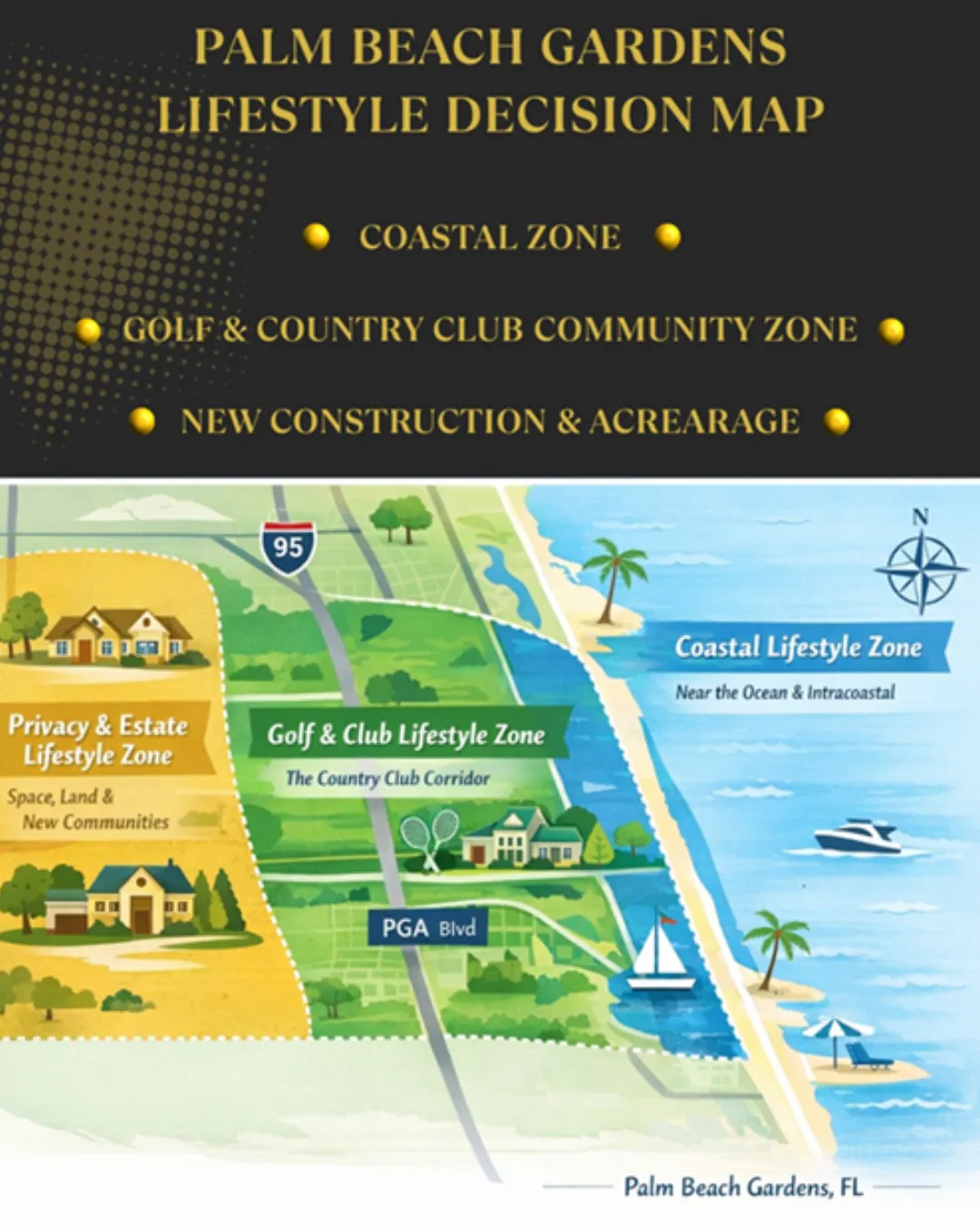
In Palm Beach Gardens, you’re not just choosing a property. You’re choosing the environment your life will operate inside of. Most of my clients are deciding between a few core lifestyle zones:
Country Club Communities (PGA / Golf Lifestyle)
Structured, social, and amenity-driven.
Great for those who want built-in lifestyle—but requires real commitment (financially and socially).
Gated Non-Golf Communities
Privacy, consistency, and a more flexible lifestyle.
Often the most balanced option—but quality varies depending on how the community is governed.
Non-HOA / Low-Restriction Areas
Maximum control and freedom.
But less uniformity—and in some cases, less predictable long-term resale.
Waterfront & Coastal-Oriented Living
Views, boating, and a premium lifestyle.
Also comes with insurance considerations, exposure, and long-term maintenance realities that need to be understood upfront.
Each of these feels completely different once you’re living in it.
And more importantly:
Each one performs differently when it’s time to sell.
The Problem Isn’t the Home—It’s Lifestyle Friction
Most buyers don’t regret the house. They regret how it feels to live there.
That shows up in ways like:
“This community feels more restrictive than we expected.”
“We thought we’d use the club more than we do.”
“This area is more seasonal than we realized.”
“It’s quieter—or busier—than we want long term.”
These aren’t issues you catch during a showing. They’re the result of choosing the wrong lifestyle zone.
Why This Matters More If You’re Relocating
If you already live here, you’ve built context over time. You understand traffic, culture, and the subtle differences between communities. If you’re relocating, you don’t have that advantage.
You’re making a significant decision:
Often in the $1M–$3M range
In a market you don’t fully know yet
Based on limited time and exposure
That’s where most of the risk is—and why starting with homes is the wrong approach.
How I Advise Clients to Approach This
Before we look at a single property, we focus on one thing:
Getting the lifestyle zone right first.
That means understanding:
How you actually want to spend your time here
How much structure vs flexibility fits you
Whether you want a social, active environment—or something more private
What your exit strategy looks like in 5–10 years
Once that’s clear, the home search becomes simple—and far more intentional.
You’re no longer reacting to listings.
You’re making decisions with context.
The Bottom Line
The goal isn’t just to find a home in Palm Beach Gardens.
It’s to choose a move you won’t regret two years from now.
That decision isn’t made at the property level.
It’s made at the lifestyle zone level.
Get that right—and everything else gets easier.
Get it wrong—and even the perfect home won’t feel right.
If You’re Early in Your Search
Stop asking:
“What homes should we see?”
Start asking:
“What kind of lifestyle are we actually choosing?”
That’s the decision that drives everything that comes next.
Download & Clickable Resources



Palm Beach Relocation FAQ
Is it a good idea to buy a home right away when relocating to Palm Beach?
Not always. Buying immediately can be risky because you haven’t experienced daily life, HOA rules, or seasonal patterns yet. Many buyers benefit from renting first, learning the area, and then buying with clarity and leverage.
Why is the first home in Palm Beach the riskiest purchase?
Because relocation buyers are making a decision without lived context. HOA restrictions, insurance costs, taxes, and resale dynamics can vary widely between communities, even when homes look similar.
Should I rent first or buy first when moving to Palm Beach?
Rent first if you’re unsure about the best community fit, want to understand seasonality, or need time to compare HOA rules and true monthly costs. Buy first if you’re highly confident in community fit and have already verified costs, restrictions, and exit strategy.
What HOA details matter most before buying in Palm Beach?
Focus on rental restrictions, special assessments, reserve funding, renovation approvals, and rules that affect resale demand. HOA structure can impact your flexibility and your ability to exit cleanly later.
How do I avoid buyer’s remorse when relocating to Palm Beach?
Slow the timeline, verify HOA and cost details early, and prioritize long-term livability and resale over excitement. The best first purchase is the one that still works after the novelty wears off.
What costs do relocation buyers underestimate in Palm Beach?
Many underestimate total monthly carrying costs—especially insurance, HOA obligations, assessments, and property tax structure. Two similar homes can have very different long-term costs.
How do I choose the right community when relocating to Palm Beach?
Start with lifestyle priorities—privacy, activity level, maintenance tolerance, and governance preferences—then filter communities by HOA flexibility, long-term costs, and resale demand.
Do I need a buyer’s agent when relocating to Palm Beach?
It’s strongly recommended. Relocation buyers face more unknowns, and a buyer’s agent helps identify community differences, verify HOA restrictions, evaluate true costs, and negotiate with long-term outcomes in mind.
Client
TESTIMONIAL
We would highly recommend Noel for any real estate transaction. We were buying from out of state and he went above and beyond to review properties for us in advance. After a prolonged search, we finally found our dream home only to have the inspection kill the deal for us. Noel handled the entire situation so well. From understanding our decision to walk away to delivering the message to all parties, he was nothing but professional. He was very supportive and two weeks later found us the home that was always meant to be ours. We cannot express how refreshing it is to work with such professional. If you have something to sell or are looking to buy, Noel is who you want to call. -Sheila E
Contact us

~Helping Clients Make Smart Real Estate Decisions~


